
AI Automation
Hyper Charge Your Data Entry With AI
We review Cloudflare's Clairic, an extraction model for streamlining typical data entry work.
Most companies now pay a large language model to read an invoice and hand back one number. That is like hiring a novelist to do data entry. The novelist can do it. But you pay for every word they write, and now and then they make up a total that is not on the page. Cloudflare thinks that job needs a different kind of model.
What Cloudflare released
On October 19 it previewed Clairic, an extraction model on its Workers AI platform. Cloudflare calls it the first of its System One extraction models. System One borrows from the idea of fast thinking versus slow thinking. These models give quick, typed answers instead of long reasoning or prose.
On November 18 Cloudflare went further. It released an updated 27 billion parameter Clairic and a new 9 billion parameter Clairic-flash. Both have open weights on Hugging Face under the Apache 2.0 license, and both run as hosted endpoints on Workers AI. Anyone can now download them and run them on their own hardware.
The release adds PDF support. One request can take up to four images or PDF pages. Line items come back as rows that keep description, quantity and price together. On Workers AI, both models cost $0.10 per million input tokens until December 1. After that the larger model moves to $0.24 and Clairic-flash stays at $0.10. There is no charge for output.
Two more facts matter for a buyer. Both models are built on Alibaba's Qwen base models. And every accuracy figure so far comes from Cloudflare's own tests, since there is no public extraction benchmark yet.
This article explains what Clairic does, where it creates the most value in business services, and where it does not. I lean toward open models where they fit, and I say where that lean has limits.
How Clairic works
Clairic does one job. You give it the input and a list of fields you want, each with a type. It hands back one typed value per field. Types include text, numbers, dates, times, durations, lists, estimates and forecasts.
A chatbot is a writer. You ask for the total and it writes a sentence, or a block of code, one word at a time. Clairic is a clerk with a highlighter and a form. It finds the value, writes it in the right box and moves on. In November Cloudflare rebuilt the inside so each field fills in its own short answer, side by side, with separate parts for estimates, dates and math. Cloudflare says this raised accuracy at a small cost in speed.
Three habits set it apart from a chatbot asked for structured output.
It leaves a box blank when the value is not there. In Cloudflare's October demo, a customer email had no tracking number. Clairic returned null. Its best guess was the $52.10 tax amount at 0.416 confidence, and the system held that guess back. A writer model can invent a value that fits the schema.
It shows its work. Each answer carries a confidence score and a probability that the value is missing. Text answers point to the exact characters they came from. Estimates and forecasts come with a range that should hold the true value eight times in ten.
It gives the same answer twice. In the same demo, Clairic's repair estimate matched on every run. The general model's estimate came back as $250, $250 and then $220.
Cloudflare is frank about the limit. Its own phrase is that the design makes every answer well formed, not necessarily correct. A typed answer can still be wrong. The confidence score is how you find the ones to check.
Cloudflare's test shows how the pieces fit together. Clairic pulled the facts from a damaged order claim. Clef, Cloudflare's decision model, chose refund or repair. A general model, GLM-5.3, wrote the reply. That chain finished in 19.3 seconds against 61.7 for the general model alone, and cost 49 percent less per million claims. The extraction step alone took 0.46 seconds against 16.1. Reviewers note the step times do not add up cleanly to the totals, and Cloudflare did not say how many runs it made. Treat the figures as a direction to test, not proof.
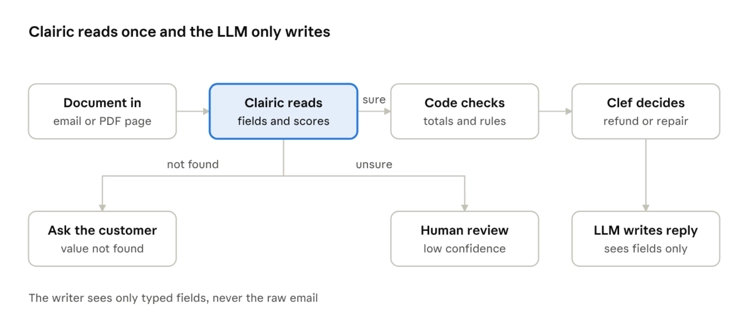
Only sure values flow on. Missing values go back to the customer, unsure ones go to a person, and the writer works from typed fields alone.
Where the value really comes from
The headline number is 49 percent cheaper. It is the wrong number to anchor on.
Start with first principles. An AI document process costs three things. Tokens to read, tokens to write, and people to fix what the model got wrong. Clairic makes reading almost free and drops the writing from the extraction step. It does nothing on its own about the people.
Cloudflare's own demo shows where the money went. In the faster chain, the reply step took 18.6 of the 19.3 seconds. Output tokens made up $5,848 of the $6,032 cost per million claims, or about 97 percent. Once reading is cheap, writing is the bill.
Now compare that with what a business process costs. Ardent Partners puts the average cost to process an invoice at $9.90 in 2026, with best in class teams at $2.67. The average exception rate is 19.9 percent. That cost is mostly labor, such as keying data from PDFs, matching invoices to orders by hand and fixing errors. At Cloudflare's preview price, reading a typical text invoice costs about $6.55 per 100,000 invoices. Scanned pages use more tokens. Even at the higher December price for the large model, the model cost is a rounding error next to $9.90.
So the token price does not decide the business case. Two things do. How often the model gets each field right on your documents. And how many documents it lets you send straight through without a person. Clairic's real gift is the second one. The blank box and the confidence score let you set a clear rule for which documents a person must see. That rule is what moves an accounts payable team from $9.90 toward $2.67.
My contrarian read is this. The winners will not be the teams that pick the cheapest model. They will be the teams that tune the confidence rule on a few hundred of their own documents and track cost per finished record.
Where it pays most in business services
Accounts payable is the best place to start, then claims and support intake. The best fit has four traits. High volume. Short documents of four pages or fewer. Answers that are typed values, not judgment. And a cheap way to catch a wrong answer before it costs money. Cloudflare itself names receipt and invoice ingestion, support ticket triage, lease and loan processing, and expense audits as target uses. Ranked against those four traits, here is my order.
| Rank | Use case | What Clairic pulls | What stays with code or people |
|---|---|---|---|
| 1 | Accounts payable and expense audit | Supplier, dates, line items and totals from invoices and receipts, even across pages | Matching to purchase orders, sums over many rows, approvals |
| 2 | Claims and support ticket intake | Order numbers, dates, amounts and damage details, plus a blank when a value is missing | The reply, refund policy and exceptions |
| 3 | Orders, shipping and returns | Order IDs, ship dates and quantities from emails and notices | Stock updates and carrier disputes |
| 4 | Agent workflows | Typed fields from tool results inside an agent loop | The agent's plan and its actions |
| 5 | Loan and lease operations | Rates, dates and amounts from a few chosen pages | Credit decisions and any page past four per call |
Accounts payable comes first because the gap is widest and the work is the most repetitive. The November release was built for it. One request can pull a supplier, line items and a total even when they sit on different pages, and each line item keeps its description, quantity and price together. Expense audits sit in the same family. Clairic-flash answered Cloudflare's expense audit test in 393 ms at the median.
Claims and support intake come second. Customer emails often leave things out. Clairic's blank box tells the system to ask the customer, instead of letting a writer model guess. There is a security bonus too. In Cloudflare's chain, the model that writes the reply works from typed values and never sees the raw email. Cloudflare says this cuts exposure to prompt injection. Prompt injection is hostile text hidden in an input, like a forged note slipped into a stack of mail.
Orders and agent workflows share the same patterns. Short inputs, many fields and frequent gaps. StackOne points to pulling fields from tool results inside agent loops as a natural fit, since some fields are often missing.
Loan and lease work is a strong but careful fit. Clairic-flash answered Cloudflare's commercial lease test in 379 ms and its loan pricing test in 188 ms at the median. But a full lease runs far past four pages, so a step must pick the right pages first. Credit decisions also carry rules of their own, so keep a person on the final call.
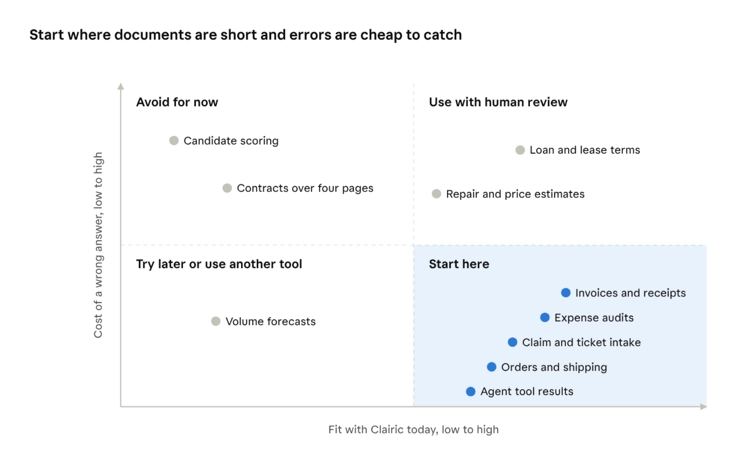
The placement is my judgment from the four traits above, not a measured score. Your own pilot should move the dots.
Where it does not fit, and the risks
Clairic is a sharp tool with a narrow edge. Four kinds of work fall outside it today.
Long documents. Each call takes at most four images or PDF pages, with 4 MiB per file and 8 MiB in total. A 60 page contract needs a step that finds the right pages first.
Long math. One or two steps are reliable, such as a total or a date difference. Long chains and sums across many table rows are not. Cloudflare's advice is to do that math in code.
Guesses without evidence. Estimates need comparables or history in the input, or the range gets wide. Ranges can also run narrow on data the model has not seen before. Forecasts are basic. In Cloudflare's 21 day airport traffic test, error averaged 3.3 percent, but the misses bunched around a holiday the data did not show. Use a real forecasting tool for staffing and budgets.
Decisions about people. Clairic can score many candidates, leads or listings in one call. Ranking job candidates is treated as high risk under the EU AI Act, Annex III point 4(a). That brings documentation, human oversight and transparency duties.
Then come the risks a CIO should weigh.
Self reported numbers. Cloudflare's tables show both new models reading 576 of 576 synthetic receipt fields. Liquid AI's D1.2 with OCR read 397 and ScaleDown's Extract read 280 in the same test. These are Cloudflare's tests on Cloudflare's workloads. Your own documents are the only benchmark that counts.
Model origin. Clairic sits on Qwen3.8-27B and Clairic-flash on Qwen3.5-9B, both from Alibaba. Running the weights in house keeps your data at home. Some public agencies and regulated firms still have rules about models from Chinese labs, so check procurement policy first.
Open weights, not open source. The weights are free to use under Apache 2.0. The training data and recipe are not public.
A young product line. Cloudflare released its first self trained models only on October 1. The $0.10 price for the large model ends December 1. Expect fast change, and pin a model version.
The hosted data path. On Workers AI, Cloudflare says it does not train on customer content and keeps it only as long as needed to serve the request. That helps. Your legal team should still map where each document travels.
Your options
Clairic is not the only way to pull fields from documents. Here is how it compares with the main alternatives.
| Option | Where documents go | Cost shape | Best when | Main risk |
|---|---|---|---|---|
| General LLM with structured output | The model vendor, or your GPUs | Pays for every output token | Odd formats, long documents, judgment | Can invent a value that fits the schema |
| Clairic or Clairic-flash on Workers AI | Cloudflare | $0.10 to $0.24 per million input tokens, no output charge | Fast start, high volume, short documents | Accuracy is self reported so far |
| Clairic weights in house | Stays with you | GPUs and staff time | Sensitive data and steady volume | You run, patch and scale it |
| NuExtract3 | Stays with you | Small 4B model, cheap to host | Lean hardware, OCR plus extraction | Smaller vendor, also on a Qwen base |
| Liquid AI d1.2 | Liquid AI | $0.02 per million input tokens | Lowest token price | Closed weights, extraction tasks are new |
| Cloud document AI such as AWS Textract or Azure | The cloud vendor | Priced by the page | Prebuilt forms and existing compliance reviews | Lock in and less control over the model |
The cheapest token is not the cheapest option. Liquid's d1.2 costs a fifth of Clairic-flash per token, but its weights are closed. That gap is only a few dollars per 100,000 invoices. Control over where your documents go can be worth far more.
Self hosting is not free either. Cloudflare has not published hardware needs. As a rough guide, Clef, its decision model on the same 27B Qwen base, takes about 55 GB of weights at full precision. Plan for data center GPUs for the large model, or start with the 9B Clairic-flash.
Our bias is a two step path. Pilot Clairic-flash on Workers AI with documents that are not sensitive, because it costs almost nothing to test. If the pilot proves accuracy on your documents, move sensitive queues to the open weights inside your walls. Keep a general model for the long tail and for writing replies. Open weights give you an exit door. That is worth more than the last cent of token price.
A 30 day pilot
Pick one queue with high volume and short documents. Invoices or claim emails are good choices. Then run four weeks.
Week 1, build the answer key. Pull 200 to 300 real documents and label the right answers. Include cases where a field is truly missing. StackOne suggests a test set of this size.
Week 2, run them side by side. Test Clairic-flash, the 27B Clairic and your current method on the same set. Score each field. Check how each handles missing values, and whether the same input gives the same answer.
Week 3, set the confidence rule. Above the line goes straight through. Missing values go back to the sender. Everything else goes to a person.
Week 4, measure the real cost. Count cost per finished record, including human review and retries. Compare it with your baseline, such as the $9.90 average invoice.
Four questions for your team this week:
- How many documents in our busiest queue does a person retype today?
- What is our cost per finished record, not per token?
- Which fields could safely go straight through above a set confidence?
- And when a model reads our documents, where do they go?
Additional Reading & References
- Cloudflare Releases Open-Weight Clairic Models for Data Extraction, Unite.AI, https://www.unite.ai/cloudflare-releases-open-weight-clairic-models-for-data-extraction/
- Cloudflare releases open-weight Clairic models for data extraction, tbreak, https://tbreak.com/cloudflare-open-weight-clairic-data-extraction/
- Cloudflare Just Open-Weighted Its Document Extraction Models, Clairic 27B and a 9B Flash, Paul Lovelace (DEV Community), https://dev.to/paullovelace/cloudflare-just-open-weighted-its-document-extraction-models-clairic-27b-and-a-9b-flash-14gp
- Cloudflare's Clairic model cuts AI pipeline cost 49% in its own test, PPC Land, https://ppc.land/cloudflares-clairic-model-cuts-ai-pipeline-cost-49-in-its-own-test/
- What is Cloudflare Clairic? The extraction model, explained, Riellvriany Indriawan (eesel AI), https://www.eesel.ai/blog/cloudflare-clairic
- What Is Cloudflare Clairic? System One Extraction Explained, StackOne, https://www.stackone.com/blog/cloudflare-clairic-extraction-model/
- Introducing Clairic, a new System One class of extraction models, Alex Reneau, Michelle Chen and Kevin Flansburg (Cloudflare), https://blog.cloudflare.com/clairic-extraction-model/
- Cloudflare releases Clef and Clef-flash decision models on Workers AI, Crypto Briefing, https://cryptobriefing.com/cloudflare-clef-decision-models-workers-ai/
- Cloudflare Clef open weight decision models, mer.vin, https://mer.vin/news/cloudflare-clef-open-weight-decision-models/
- Workers AI privacy, Cloudflare (developer docs), https://developers.cloudflare.com/workers-ai/privacy/
- Invoice Management Statistics 2026, Tailride (summarizing Ardent Partners via Medius), https://tailride.so/blog/invoice-management-statistics-2026
- Invoice processing time benchmarks, ProcureDesk, https://www.procuredesk.com/invoice-processing-time-benchmarks/
- Employment use cases under Annex III, European Commission AI Act Service Desk, https://ai-act-service-desk.ec.europa.eu/en/node/464
- Numind releases Apache-2.0 4B vision model for document extraction, AI Weekly, https://aiweekly.co/alerts/numind-releases-apache-20-4b-vision-model-for-document-extraction
- Liquid AI Releases d1.2 and d1.2-ultra, Tech Jack Solutions, https://techjacksolutions.com/?p=111468
- d1.2 model specifications, LLM Reference, https://www.llmreference.com/model/d1.2
© 2026 Symvoulos LLP. You may quote or excerpt this article with attribution and link to the original URL as well as referenced material. Republication in full, adaptation, translation, or use as the basis of derivative or secondary works requires attribution. Removal or alteration of attribution is prohibited.
Stathy Touloumis is President of Symvoulos (Symv), a boutique technology consultancy serving all sectors of business and government entities including regulated enterprises. His experience spans over 30 years with most recent to state, local, and public entities across infrastructure modernization, security, service delivery strategy, and the governance questions raised by AI adoption. Symvoulos’ expertise starts where most stall: multi-year cost models, risk vectors and staffing plans an agency can defend in a budget hearing. Be sure to follow us at symv.ai
Want to talk about your own case?
Share a few details. A person on our team will reply.
Start a conversation